Thursday, January 17, 2013

Funeral Potatoes

A note about the pictures this time. I'm experimenting with a High Dynamic Range photo app on my phone. So you'll notice some odd highlights in some of the pictures as I figure this out. 

In my neck of the woods, Funeral Potatoes means a mixture of convenience items mixed together and served by caring friends and neighbors to the grieving family after the funeral services.

It's basically a form of Au Gratin potatoes itself a variation on the classic Gratin Dauphinois (Wikipedia details link). I've never successfully made Gratin Dauphinois. It always curdles on me. I think it's because of my altitude and that the cream comes to a boil at a lower temp than lower elevations. So I've come to rely on a roux-based bechamel sauce to reinforce my sauce for these sorts of potato dishes. 

I needed to hurry things along, so I chopped up potatoes and set them to simmer in some seasoned water.

This is about 10 cups  total of 3/8 inch cubes raw russett potato. The water is seasoned with some kosher salt (1 teaspoon), onion powder (1/2 teaspon), garlic powder (1/4 teaspoon) and dried thyme (1/2 teaspoon)  These are the flavors I wanted to infuse into the potato.  Simmer the potatoes about 15 minutes. They'll be mostly cooked but not completely so at that point.


While that's coming to a simmer, I chopped up 4 green onions, green and white parts. 


And minced 2 cloves of garlic. Whack the clove or garlic wtih the flat side of your chef knife. This breaks the clove up a bit and loosens the skin from the clove of garlic. Pick out the skin.


Chop it up.

Sprinkle it with kosher salt.


Drag the knife edge across the garlic and salt with some force. You'll feel and hear the salt grains cut apart and grind the garlic. 


Repeat that a few times to create a garlic paste. 


Melted 3 tablespoons of butter, whisked in 4 tablespoons of flour to form a roux.


Let it cook a minute or so to cook out the flour. In the last 30 seconds of that roux cooking, add the minced garlic and stir to develop it's flavor. 

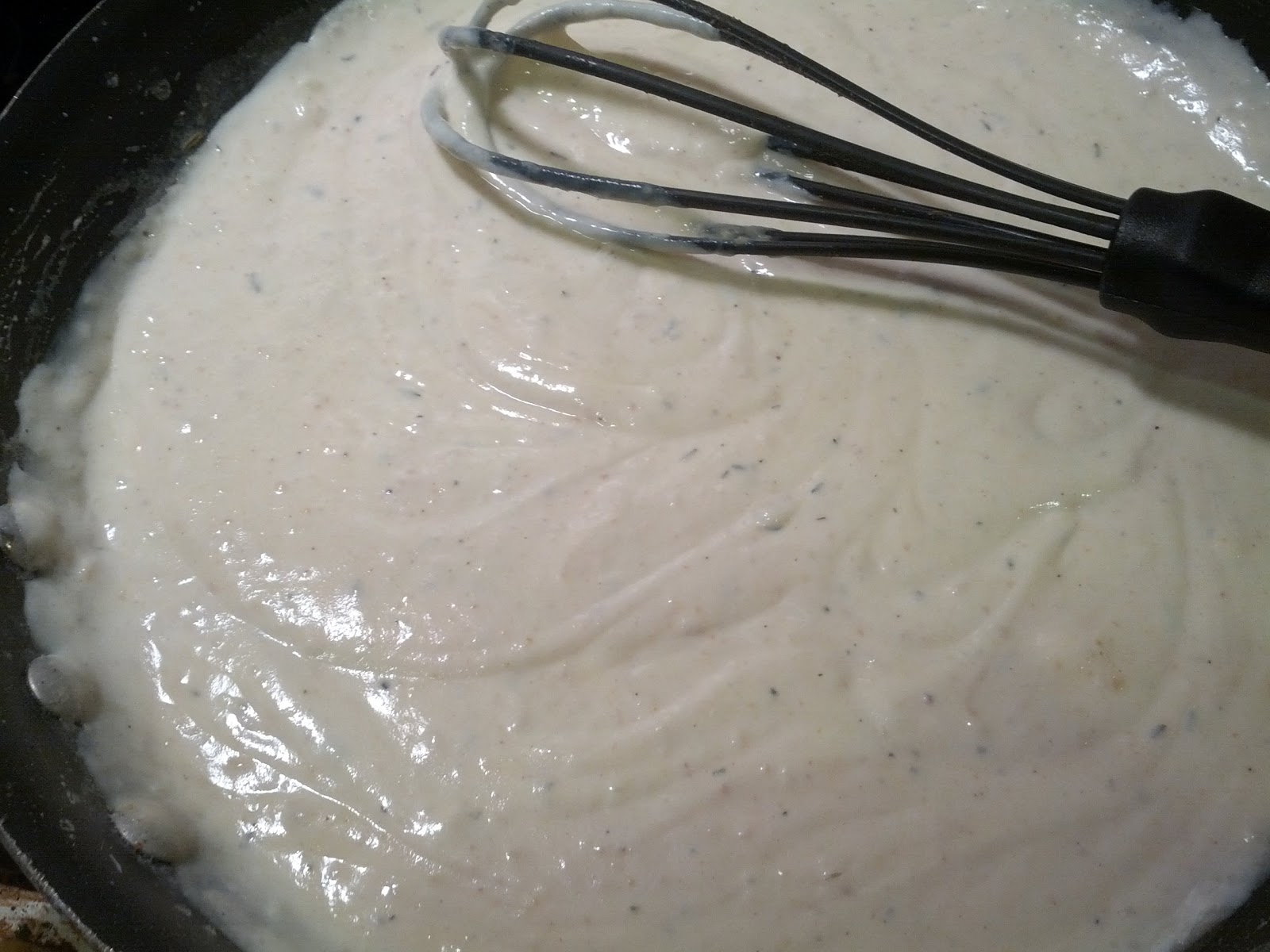
Add 2 cups of milk, whisk to form a bechamel. 

Where funeral potatoes use a can of cream of something soup, I opt for a simplified Supreme Sauce (a form of veloute) instead, being a sort of comination of bechamel and chicken stock thickened with roux.

Season with 3 teaspoons chicken base. 1/2-1 teaspoon dried thyme, pepper to taste.  Continue cooking until it thickens and starts to boil.


Add 2 cups sour cream and mix together.


Grate parmesan cheese. This is hard to give a consistent measure for as people's graters are different and so the result packs differently. So it's about an ounce to an ounce and a half of freshly grated parmesan. i grate mine on a Microplane grater. This will provide extra cheese impact in the dish without looking so heavily full of cheese and dense.


Add the cheese and the onions to the  sauce.


Combine. Taste and correct seasoning as needed. 


Add the drained potatoes to the mix--they should be about done now anyway or cook further as needed to the par-cooked stage.


Stir to combine.

Sprinkle on about 1/4 cup grated sharp cheddar cheese. This is mostly for looks so there will be strands of orange cheese in the casserole. 


Pour all that into a 9x13 baking dish.


Top with grated cheddarBake at 350 until bubbly and the top has browned, about 30-40 minutes


Serve while hot. 

Saturday, November 3, 2012

Copycat Panera Bread Company Souffles

This recipe has been kicking around the internet for a few years. I've made it twice now. The first time without as much success as the second, but I'll help you avoid my mistakes.

You can get the recipe nice and legally from this ABC newscast link as this is Todd Wilbur's copyrighted work. The first time I thought the microwaving of the scrambled eggs seemed needlessly tedious and slow and so I did the par scramble in a frying pan. That came out dense and less appealing than anything with the name souffle.


The key step is the microwaving and stirring in between bursts. It does give the eggs the structure and lift to pull this off.  Like so many home cooks, I felt it was OK to change the recipe for my convenience but there are risks to that attitude with this dish.

I happened to just use some sausage and cheese this time, as that's what was waiting to be used up. I'm not totally cured of changing recipes. That change was a safe substitution.  


If you follow his recipe, you're stuck in making this recipe in multiples of four because that's what the tube crescent dough supplies. Any extra souffles will freeze well if you let them cool first and then wrap them tightly. Reheat in an oven or toaster oven. A microwave would work too, but will give you a soggier bread crust.

I'm thinking next time I'll try it with Pepperidge Farms puff pastry from the freezer case. I think that will give an even better texture to the crust and still be easy to do.

Monday, October 15, 2012

Towards a Theory of Chinese Marinades: Part I

This a topic I'll Likely revisit, thus the numbering. 

Executive Summary:
This is a long entry, so you might like an early summary. Balanced seasoning of salt and sweet through either salt/soy and wine/sugar with other aromatics representative of the chef.


Most stir fries marinate the protein in at least some soy sauce and rice wine, usually in equal parts. While reading Ken Hom's  Top 100 Stir-Fry Recipes, I noticed that he'd vary his marinades by a teaspoon of soy or rice wine now and then, and he used sesame oil in a lesser amount quite often as well.  And I wanted to understand why. 

That started me going back through some of my favorite Chinese cookbooks and looking carefully at the recipes and thinking about their construction. All this an effort to make my Chinese cooking more intuitive and flexible. But it's been educational as well.  This first entry then catalogs the authors I refer to most frequently and includes an effort to distill their basic marinating practices.


Ken Hom
 I don't actually own any of his cookbooks, though I've read most of them, and have been reading a few of his newer ones from the library recently. I did quite like his recent Complete Chinese Cookbook and have been waiting for the price to drop before I add it to my collection. 

If I were to characterize Ken Hom's marinade, for 8 oz of protein, it would be:
1 Tablespoon light soy
1 Tablespoon rice wine
2 teaspoon sesame oil
2 teaspoon corn starch 

He tends to reduce the wine by a teaspoon if the dish has a more pronounced earthy flavor, such as from dark soy, peanuts or with lamb or mushrooms as the main ingredient. If he's going to pass through oil or deep fry the protein, it's usually just egg white, sesame oil and corn starch. He'll reduce soy and the wine even more if seasoning with citrus flavors in the sauce as in his Quick Orange and Lemon Chicken which doesn't use a battered chicken. Apparently to not compete with the citrus flavors.


Martin Yan
Martin Yan can be pretty varied in his marinades, but his most consistent ingredients are soy, wine and cornstarch, heavier on the cornstarch than most. Ginger is probably his most frequent aromatic to add to a marinade, but oyster sauce appears a surprising amount as well.

1 Tablespoon soy, could be light, or dark, or even a T of each.
1-2 Tablespoon rice wine
1 Tablespoon corn starch


Yan-Kit So
She constructs more complex marinades, tends to marinate longer  and with a twist on adding the oils for the last half or third of marination time. I think it's interesting that she breaks with the equal parts of soy and shao hsing wine and also the addition of plain vegetable oil in combination with the sesame oil.

If I average her most commonly used ingredients, then this is her marinade for 8 oz of protein. Marinate 1 - 2 hours in the refrigerator; combine the oils and stir in for the last hour.

1/4 teaspoon salt
1/2 teaspoon sugar
1 Tablespoon light soy
2 t shao hsing wine
1/4 teaspoon black pepper (8 grinds is her usual specification)
1 1/2 teaspoon corn starch
1 Tablespoon vegetable oil
1 1/2 teaspoon sesame oil

I did learn some interesting things from her about ginger and alcohol in marinades with a little help from the people at Cheftalk

And Fuschia Dunlop lists Yan-Kit So as one of her more important influences.


Nina Simonds
As with the others, there's a fair bit of variation customized to the recipe at hand, but I'll delve more into how marinades reflec the ingredients in another posting.

1 Tablespoon light soy
2 teaspoons shao hsing
1/2 teaspoon sesame oil

That forms her baseline. 2 t water, 2 t corn starch make enough appearances for an mentioning but not enough to be part of the baseline. Aromatics like ginger, garlic, and green onion are more likely to appear in her marinades than anyone else.


Eileen Yin Fei Lo
I cannot construct an averaged marinade for her. She's too varied in her marination practices and is prone to include some western ingredients as substitutes for hard to find Chinese wines and spirits.  She does use oyster sauce in marinades more often than most. Martin Yan is probably the other frequent user of oyster sauce.  She'll likely get her own Marinade topic after I spend more time trying to figure out what she's up to.  There's a lot of depth to her knowledge and experience.

However, from perhaps her simplest cookbook My Grandmother's Chinese Kitchen, I think there is a baseline marinade that can be extracted and looks like this:

1 Tablespoon light soy
1 Tablespoon shao hsing
1 Tablespoon oyster sauce
1 1/2 teaspoon sesame oil
1/2 teaspoon salt 
1 teaspoon sugar 
pinch white pepper
2 teaspoon cornstarch

The recipes in this particular book reflect what she ate growing up and in learning to cook. So there is less meat marination going on to draw this baseline from than in her other books. But it does exhibit the kinds of flavors she grew up on. And I think this book is quite an enjoyable read in its own right for her life story.


Barbara Tropp
1 Tablespoon light soy
1 Tablespoon shao hsing wine
1 1/2 teaspoons corn starch
pinch of sugar

Like Nina Simonds, Barbara Tropp is prone to include garlic, ginger, green onion as well as hoisin, but she also exhibits a tweak where she'll skip soy and use salt or skip wine and use sugar.


Grace Young
Most of Grace Young's cookbooks compile recipes from other cooks, but The Wisdom of the Chinese Kitchen does capture much of her family cooking. I think there are really interesting parallels between this book and Eileen Yin Fei Lo's My  Grandmother's Kitchen. Both tell the tale of growing up Chinese and eating Chinese food and learning to appreciate it. But Grace Young grew up in San Francisco and in a more recent time. But what they share is surprising. Both are filled with good tales of family, food and life. Read them together, it's a good experience. Both have very few stir fried protein dishes too showing that how we eat in the west at Chinese restaurants is not so much how Chinese really eat.

1 Tablespoon light soy
1 Tablespoon shao hsing wine
1/4 teaspoon salt
1 teaspoon sugar 
pinch of pepper

Cornstarch does make an appearance in her marinades, but not as often as with other authors. 


Kenneth Lo
Most of his cookbooks are out of print but worth seeking out. Grace Young uses him for recipes in a few of her books.  I want to mention 3 in particular. 

Step by Step Guide to Chinese Cooking  This is from 1974 and expects that about the most authentic ingredient you'll be able to find is soy sauce. The cooking is quite different from what we'd expect today but is still respectful to the cuisine within the limits of what was available. So the recipes are carefully chosen to use only simple widely available seasonings. Perhaps the most noteworthy thing is the use of Chicken Bouillon cubes as a seasoning, something referred to as Chicken MSG in the restaurant trade of the time.  It's surprising what he pulls of in this short cookbook.

Chinese Regional Cooking from 1979 seems to be written to preserve hotel and restaurant cooking from all over China of the time as well as from regional archives. Very different recipes from what you're used to seeing in contemporary cookbooks but they work pretty well. This was written at the time that China was switching to the current form of pinyin but Lo chose to use the more familiar terms of the time. So Peking instead of Beijing and that sort of thing.

New Chinese Cooking School is from the mid 1980s but full of good color photographs and well written recipes. Barbara Tropp is still tops at teaching technique, but the pictures here and the recipes are better than Barbara's.

He's difficult to pin down on a seasoning marinade which he uses only rarely.  He uses velveting techniques a lot so there's a lot of cornstarch and egg white marinades. Also a fair bit of rubbing meat with salt and ginger, which is then paired with the egg white and cornstarch in different ways. 


Fuschia Dunlop
She  writes detailed well-researched cookbooks and has been very regionally focused in what little she's published so far.

Wine and salt comprise the most common marinade, though usually something else is also included. Ginger and green onion probably most often, but cornstarch is pretty common too. Not much soy in the marinades here. 

1/2 teaspoon salt
2 teaspoons shao hsing wine

1 1/2 inch piece of ginger lightly crushed
3 scallions, white parts only, light crushed

Part 2
Part 3 
Part 4


Saturday, September 15, 2012

Rice Paper Bowls

While browsing through one of the local Asian grocers today, I saw something new. A specialized bowl for soaking rice papers. I thought it was a pretty slick idea to simplify the process, not use so much water and so on. Most have a rack or slot on the back to hold dry papers, but I think that's asking for trouble. I'd probably drip or spill some water into them. 

No pictures of my own yet, but Amazon has a few different ones that illustrate the idea.  In no particular order:
Check your local stores if this looks like something you'ld like. They were cheaper than Amazon in my case.


Friday, September 7, 2012

Cheese Souffle

Cheese souffle may sound daunting and while it my have more steps, nothing is difficult to do. 

2 cups bechamel sauce
6 eggs, yolks and whites separated
1 1/2 -2 cups sharp cheese or blend of cheeses
butter
grated parmesan

Starting with the bechamel sauce.
3 tablespoons butter 
4 tablespoons flour
2 cups milk
salt and pepper to taste
pinch of ground nutmeg

Melt the butter in a skillet over medium heat. 


When the foaming stops, whisk in the flour and stir to form a roux. 


 Cook the roux, for a minute, stirring the whole time. This cooks out the raw flour taste. 


Add the milk and keep whisking, raising the heat until the sauce thickens or just until it boils which. It's at its thickest just before boiling, but you won't hurt anything if it comes to a boil. Season to taste, remembering you'll be adding cheese and eggs.  Melt the cheese into the sauce and set aside to cool.


Heat the oven to 375 and set the rack to the middle of the oven.

Rub the inside of individual six 8 oz ramekins with butter. Add about a tablespoon of grated parmesan to the ramekin and tilt the ramekin so that the parmesan sticks to the butter. Pour the excess parmesan into  next ramekin and repeat adding more grated parmesan as needed.

Confession, I had my daughter do this step and she used cheddar on my microplane grater. This doesn't work as well for coating the ramekins but it still made a pretty good souffle. And she'll remember the parmesan next time.  Arrange the ramekins on a baking sheet.


Separate the eggs. If you're new to separating eggs, it's wise to separate into a bowl one egg at a time. So if you get some yolk in the white, it only messes up one egg white, not all of them. Discard that one and try again.


 Don't worry if you break one or more yolks. It's just fine.


In a metal bowl, beat the egg whites to stiff peaks. Plastic bowls tend to have a light oil film which inhibits the whites from whipping as nice or as high. Glass bowls are fine to use too.


Beat the yolks. If the cheese sauce is still hot, you'll have to temper the yolks so they don't cook as you combine them with the cheese sauce. Temper the yolks by adding small amounts of the cheese sauce to the eggs while you mix. Continue until you've doubled the volume of the yolk mixture, then add the rest of the sauce and yolk mix and stir to combine. If the cheese sauce is just warm, you can just stir the yolks right into the sauce. 

I just picked up some of the hot cheese sauce on the whisk and whisked to start tempering the yolks. 


 Need a bigger bowl. Didn't think ahead on that one. Continue adding cheese sauce in small amounts and whisking.


And then you're done combining the yolks and sauce.


Fold half the whites into the yolk and cheese mixture. This lightens the mix and makes it easier to fold in the last half of the whites with the least loss of volume.


Then repeat with the last half of the yolk mixture. Don't stir or whisk as you'll deflate your whites. Don't worry if the final souffle batter is not perfectly mixed. A few white splotches in the batter is better than deflated whites. 


 All mixed up and ready to pour into the ramekins. Notice there are still swirls of lighter and darker areas. No need to overmix.


Pour the batter eveinly into the prepare ramekins. As I'm cooking for five not six, I'm using a larger ramekin and will cook it slightly longer.


Bake for 20-25 minutes. They'll still have some jiggle. Below they're all finished. Notice they rose about 2 1/2 inches.

  
Serve immediately. They deflate quickly.


Went a hair too long so it's a bit darker on top than is ideal, but still a very good souffle.

The ratios in a souffle are actually fairly easy to adapt up and down for different servings.  1 egg, 1/4 cup bechamel 1/4 cup cheese and you're there for a single souffle.


Tuesday, July 31, 2012

A Rice Bowl with Vietnamese Flavors

This is not an authentic or traditional dish. Rather, it uses good technique and flavors to get to the final product.  I created this dish because it embodied flavors I was in the mood for and used up things I had on hand.  I decided I wanted a Rice Bowl, a bowl with rice on the bottom topped with various vegetables and meats unified by the final sauce or broth. I looked through a couple of cookbooks for ideas and concepts that resonated with my cravings and supplies. 


They all had dishes of interest, but Nina Simonds had a Stir-Fried Beef with Vegetables over Rice recipe on page 43 that gave me a framework and a feel for ratios that proved the most useful. She used 3 cups of stock for her sauce, but I didn't want my rice bowl to be that saucy so I made a smaller batch. Adjust sauce amounts up or down to match your preference.

I had the tail end of box of large button mushrooms (about five or six left), some green beans and about 10 oz of pork I wanted to use. 

The green beans have a longish stir fry and minced garlic and ginger tends to burn in that situation so I cut them in slices so they'd stand up to that prolonged cooking, something commonly seen in Italian cooking (minus the ginger).  The pork, I decided to go with an onion and black pepper stir fry; and the mushrooms, I would stir fry at lower heat and seasoned with oyster sauce.


1 1/2 cups long grain rice

5 or 6 large button mushrooms, sliced thinly
1 pound green beans cut into 1-2 inch pieces
1 onion, sliced julienne
10 oz pork, sliced julienne
3 tablespoons cooking oil
large handful of spinach including some mixed mesclun if you like

Pork Marinade
1 1/2 teaspoons light soy
1 1/2 teapsoons shao hsing wine
1/2 teapoon corn starch
zest of 1 lime grated finely
1/4 teaspoon dried basil, crumbled between your fingers.

Seasonings
2 inch finger thick ginger peeled  and sliced thinly (or equivalent amount of thicker ginger is fine too of course. That's just the size of the knob I used.)
4-5 cloves garlic peeled and sliced thinly
1 tablespoon soy sauce, divided (or to taste)
1 tablespoon shao hsing wine
salt
pepper
1 tablespoon oyster sauce


Sauce mixture
2 cups chicken stock
1 small star anise
1 clove
small pinch of cinnamon
2 tablespoons palm sugar or brown sugar
2-3 tablespoons fish sauce or to taste
1 1/2 tablespoon ketchup
dash of sriracha sauce to taste 
corn starch slurry to thicken to preference
juice of 1 lime

Start the rice cooking, then combine all but the last two ingredients of the sauce mix. Let that simmer along about the same amount of time the rice cooks. If you're using a rice cooker, most have longer cycles than will take for the sauce to cook. The sauce only needs about 15 minutes of cooking, which is about what the stir frying steps will take so match the timing of your rice, sauce, and stir frying.


Heat a wok over high heat until smoking. Add about a tablespoon of oil around the edges to coat the wok. Add the green beans and stir fry 2 minutes. Add half the ginger and about half of the garlic. Stir fry another 2 minutes. Add the shao hsing wine and a splash of soy sauce. Cover and let steam 1 minute, then finish stir frying to your desired doneness. The beans should have brown spots and a few black blisters.


Remove green beans to a serving bowl.

Return the wok to high heat. You shouldn't have to clean the wok as there will be no small bits or sauce stuck to the wok. Add about a tablespoon of oil around the edges to coat the wok.

Add the pork and spread out to let sear for 60-90 seconds. Meanwhile, season with some ground black pepper to taste. When the pork has picked up some sear, stir fry another minute or two and remove to a serving bowl. 

Add a little more oil to the wok if you think it needs it.  Then add the onion to the wok, and about half the remaining garlic and the rest of the ginger.  Stir fry for about 2 minutes with a splash of soy sauce and more pepper. Then add the pork back to the wok and stir fry another 60-90 seconds for the pork to pick up some of the flavor of the aromatics. 


Remove the pork and onions to a serving bowl.
Return the wok to the heat, add the rest of the oil and lower the temp to medium high. Your wok will have some bits from teh pork and onions, but that's OK. Just get cooking quickly before those bits burn. Add the remaining garlic, and the mushrooms. Stir fry until the mushrooms have picked up some color., about 2 minutes. Season with a little salt and pepper, and reduce the heat some more. Stir frequently, but not at the level of a true stir fry and keep cooking. The mushrooms should darken, give up liquid and shrink after a few more minutes. When the moisture has cooked off, add the oyster sauce and reduce the heat to low. 


Stir to mix and let cook slowly for a few minutes, with occasional stirring. I wanted to concentrate the mushroom flavor in the mushrooms with the sauce, not leave them crisp tender as in most stir frying.

Put the spinach in a serving bowl. 

While the mushrooms finish cooking, complete the sauce. Bring the sauce to a boil. While it's coming to the boil, remove the star anise and clove. When the sauce is boiling, thicken with the slurry to your liking. I mixed it pretty thin, just to add some body to the sauce. Then stir in the juice of 1 lime and remove from the heat. 


Everything should be done now and you're ready to eat.


Build your rice bowl in layers with rice in the bottom, the spinach leaves next, then the beans, mushrooms and top with the pork and onions. The heat from the rice and other cooked items will start wilting the spinach.

Ladle in some hot sauce to your liking, I used about 1/3-1/2 cup of the sauce, which will help the spinach cook.

My son went for the all mixed together approach to the dish.