Friday, May 23, 2014

Frittata

Frittata is a baked Italian style omelette. It shares some concepts with the Spanish Tortilla, but the fillings are often more diverse. I like the frittata as a simple way to repurpose leftovers quickly into something tasty.

The concept is simple. A 10 inch skillet. Nonstick or well seasoned cast iron or carbon steel simplifies things a lot and I strongly recommend one of those choices. It needs an oven proof handle as well, at least for the technique I prefer.

The ratio is this: 6 eggs to about 3 cups of filling. The filling usually includes something starchy like potatoes or pasta, some vegetables, often some herbs and some meat and/or cheese. For this fritatta, I'm using up some leftover linguine in a tomato sauce,  some sauteed zucchini and patty-pan squash, some cut up ham, and a mix of Romano and Parmigiano cheese.

I tend to cook on a lower heat for a longer time than many other frittata recipes you'll see. Those frittatas have a darker overcooked egg surface that is less appealing. You'll see.

Season your eggs. I chose some Goya Adobo, black pepper and a little garlic Cholula hot sauce. That's what I most often s eason my eggs with for most any savory purpose.  Then beat the eggs.

Add your filling choices. Mine were pasta, squash, ham and cheese. 

Combine those. 


Heat your pan over medium heat. Add about 1 tablespoon of olive oil. Tilt your pan to coat it evenly. I don't recommend butter. The milk solids tend to overcook and darken the surface of the fritatta and tastes a little off from the longer cooking time of this dish.  

Add your fritatta mix. It will set around the edges slowly. Lift the edges and let some egg run under and cook. Do this around the fritatta twice. 


Meanwhile, heat your broiler and position your rack about 6 inches from the heat. You can see on the right of my photo I'm down one notch on the position in my oven. Also note that I removed the cover from this pan's handle so it's safe for broiler temperatures. 


The surface will set before it's done cooking. Look for the surface to pick up some color is useful clue. When you see some color, to see how the fritatta jiggles. If it moves fairly uniformly it might be done. if the center jiggles more than the edges, it needs to cook some more. You can test it pretty simply for doneness. Poke a knife into the center and look for liquid. If you click the photo below to see it larger, you'll see the liquid shine by the blade. Some recipes say that it will finish cooking from the carryover heat outside the oven, but I've been burned by that technique. If you like your omelets with a littlye runniness in the french style, that's fine. That's just not my preference. The surface here can take a little more browning. so I let it go another 2 minutes under the broiler At that point, it had enough color but was still wetter than I liked so I turned off the broiler, and let the frittata bake in the closed and cooling oven about 5 more minutes


Compare the browning in mine to the wikipedia frittata-photographed by flagstaffotos. Their egg surface is overcooked and will have poor texture and flavor. 


Generally, recipes tell you to invert onto a plate. Plates don't give you a lot of extra rim if you're not experienced at that inverting thing. This is where the non-stick cooking surface helps out. A cutting board is easier I think than a plate and it's much easier to cut and better for the knife. 


Then slip it onto the serving plate.

Good warm or at room temperature. 


Sunday, May 11, 2014

Steamed Eggs with Dried Mushrooms

This is a simple dish and most often an inexpensive one. It's a simple savory custard. I've not come across it in restaurants, but it shows up in a number of cookbooks.  You'll often see it with shrimp or ham. Dried or preserved meats are the more traditional but fresh shrimp is probably what I see the most of in modern cookbooks and websites. The toppings are usually on the salty side to accent the mild custard. It can be made in individual servings or in a single larger vessel.

This is a dish of ratios that's easy to expand or shrink as needed, and it's one reason I prefer to make it ramekins so I don't have to hunt up a dish of the right size or worry about different timing.

Per person you want to feed:

1 large egg

1/4 cup + approximately 1 tablespoon extra stock/liquid appropriate to the protein garnish. If you're using dried ingredients, you can use the leftover soaking liquid from re-hydrating them. Keep the extra amount for building the sauce.

salt to taste for the eggs/stock combination. Soy sauce can be used to, but keep in mind the final color of your custard.

white pepper or hot sauce to taste--I used black pepper in the photos for this post and it doesn't look right as you'll see.


Sauce: amounts for 1 person are so small, I left them unstated. I give the amount I used for 6 in parentheses

about 2 dried mushrooms per person
minced garlic ( 2 medium cloves)
minced ginger (1/2 inch piece peeled)
rice wine (2 tablepoons)
the extra mushroom soaking liquid, strained of grit (a bit under 1/2 cup)
soy sauce (1 tablepsoon)
oyster sauce (2 tablespoons)
corn starch slurry as needed

For the photos here, I was making this at a friend's house I brought my steamer and the basic ingredients, but was counting on my friend for basic seasonings, thus my use of black pepper. Further, I was cooking for 6 people including a seafood allergy and a vegetarian, so dried mushrooms were the proper ingredient.

Using the common dried black mushroom commonly used in Chinese cooking will work just fine. They're in the big tub on the right. But I had a few other types of dried mushrooms and thought they'd be fun to work with in a blend.


Add your mushrooms to enough water to cover. Bring to a boil, or just pour boiling water over your mushrooms. Let stand off heat 20 minutes. Reserve all liquid, but strain out any grit.


I like to wring out the mushrooms lightly in my hand so they're not soggy. Again, keep the liquid. Then chop them up.

Set up your steamer, fill with water, enough to boil for 10 minutes or so, and put on the heat. 

Combine the eggs, the amount of stock or soaking liquid and seasonings. My friend had no white pepper and while he as hot sauce, I just grabbed black pepper without thinking much about it.

Portion into the ramekins. When your water is boiling, load your steamer. I'm using a 30 cm, two level stainless steel steamer. Steam about 10 minutes. Time will vary with the shape of your ramekins and your altitude and such. I'm cooking at close to 5000 feet so your cooking time may vary. Watch closely the last few minutes so you don't overcook your custard.  The lower tier will cook faster and is more prone to bubble and froth.


You can carefully scrape the surface of the custard if it is bubbly or frothy to improve the appearance and delicacy of the dish.  Or if you're going to sauce if more heavily, it doesn't matter as much.

While the eggs are steaming, prepare your sauce.

Heat a little oil in a wok or pan. Add the mushrooms, garlic and ginger. Stir fry/saute for a minute or so for the flavor to develop. Reduce the heat and let it cook another minute, stirring frequently. Add the rice wine, mushroom liquid, soy sauce and oyster sauce.  Let it simmer for a minute or two, then adjust to your texture preference with the corn starch slurry.


Plate the individual ramekins and garnish with the mushrooms in the sauce. Here's where the black pepper choice reared its head. Notice the black specks especially along the edge of the custard. That's the pepper. Kind of messes up the look of the dish. It tastes just fine of course, but presentation counts too.


This is a versatile dish and can be served at breakfast, lunch or dinner. It can be an elegant course in a larger meal. 

V gives a good version of this with shrimp where she makes a shrimp stock from the shrimp heads and shells as well as some kombu.

Lee Kum Kee offers this shrimp version with XO sauce. I like the idea, but would have to reduce the amount of XO sauce as it's usually much hotter than I enjoy.

The ham variation is often not sauced or perhaps sauced with a simple clear michiu sauce. I see people often mix in the ham with the uncooked egg. That always settles to the bottom when I try to cook it that way. Others will add the ham in the last third of the cooking time when the custard is thick enough to support the ham.

Wednesday, April 16, 2014

Breakfast Enchilada Stacks

There's a handy coincidence between 6" corn tortillas and an 8" nonstick pan.


The flat cooking area at the bottom of the pan is just right for the tortilla and makes an egg omelet that matches in size. 


Ingredients

  • Package of corn tortillas, about 20, I'm partial to the white corn, but yellow is equally good. 
  • 5 eggs-seasoned to taste and beaten--I used adobo and cholula hot sauce
  • 12-16 oz Mexican chorizo sausage. I used a Cacique brand beef chorizo. Chorizo can be fairly hot to some tastes. You could use a breakfast sausage or other similar item of your choice.
  • Grated cheese, cheddar, jack, oaxaca would all work well. I used cheddar
  • Enchilada sauce-- I used a can of Hatch Green Chile Enchilada sauce Other brands or recipes would be fine. 


Heat an 8" nonstick skillet over medium heat. Spray LIGHTLY with  nonstick spray.


Pour in about half an egg's worth of the egg mixture.

Tilt the skillet to coat the bottom of the pan evenly


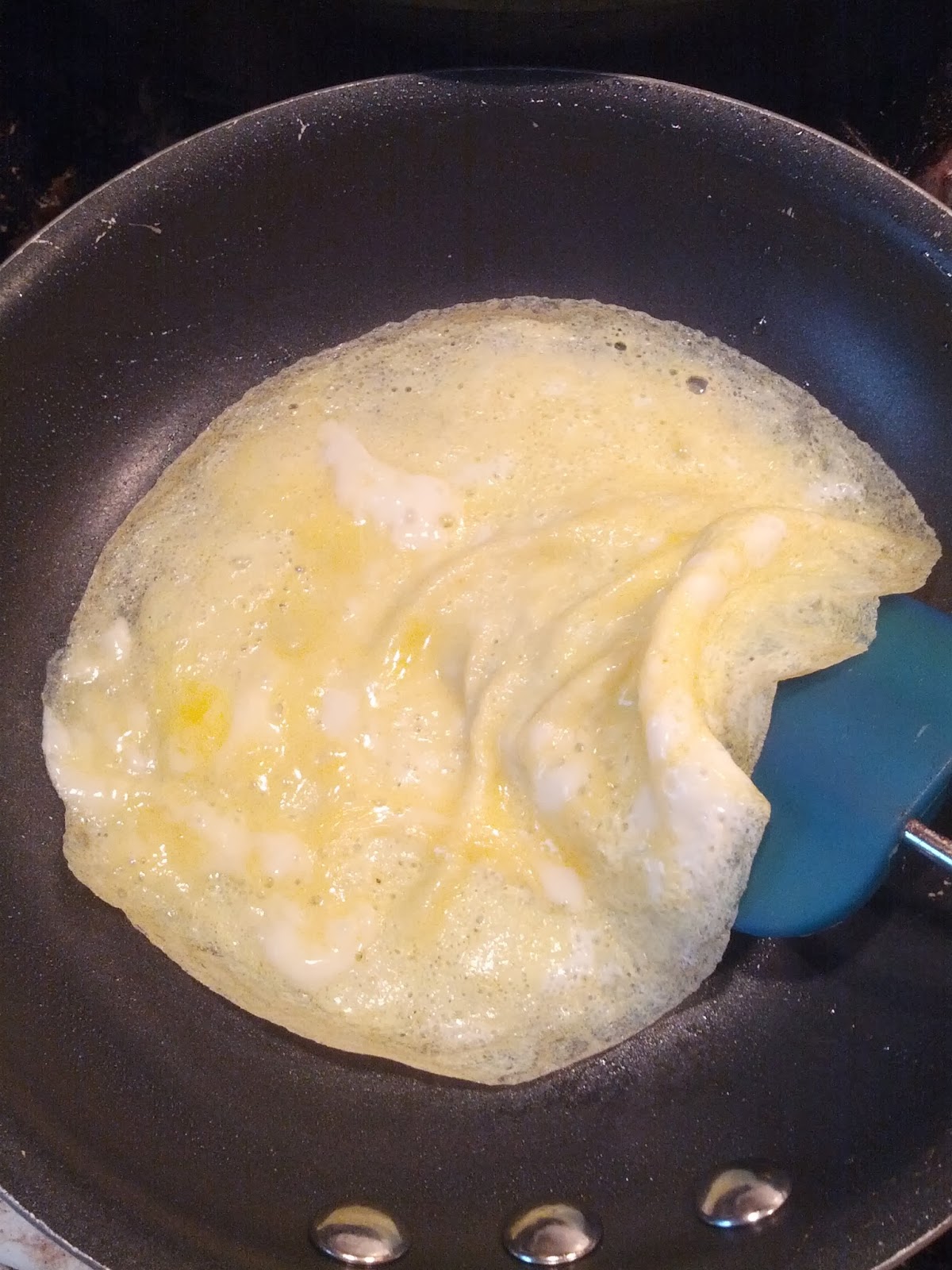
When it just looks moist on top, it's ready flip. Notice also that the very edges have dried and curled away from the pan a bit.


They're too light to reliably flip with a pan toss. Slip a silicone rubber spatula under the omelet, lift, flip and straighten it out.


Don't sweat the small tears. They'll work fine. You'll break some occasionally. That's OK for this recipe.


Here's a good one. Usually the first or second one are more prone to break because the pan isn't evenly hot and slick as it will get when fully hot. After the first two, I usually turn the heat down a bit as well.


Set them aside for use in the enchilada stacks.


Cook off the chorizo, drain excess fat.

Low fat enchiladas usually have some trouble with the corn tortilla breaking up as it absorbs the enchilada sauce. This is particularly pronounced in the rolled version of the enchilada. Cooking the tortilla in oil helps it hold together and produces a better texture.

In this dish, I just sprayed my non-stick pan with a little spray oil and let the tortilla cook in that until brown spots form. Repeat on the other side.

And I only dipped the tortilla in the chile sauce on one side rather than a full immersion. I stacked the dipped tortillas so they still had chile sauce on both sides, just not a lot of it.


Spread a little enchilada sauce in the bottom of your baking dish. This will keep things from sticking.

Start building your layers, each layer with only one ingredient, though it's OK to mix ingredients too. You just want to keep each layer thin. You can build small individual serving stacks of just one of each layer or large stacks of repeated layers.

A layer of egg, then a layer of cheese.


A layer of chorizo. Whoops, also a layer of cheese on one of them. A layer of egg on the next one. Repeat. Finish with a layer of cheese.


I did this the night before breakfast and refrigerated it to bake in the morning.

Set your oven to 350 and bake until bubbly and browned, about 20 minutes.

For a tall stack, cut it in wedges and serve.


Friday, March 21, 2014

Chinese Cooking by Region

Every cuisine has regional aspects that reflect the climate, what's available and the traditions that have developed. There's usually some variability in where the lines are drawn or what is considered typical. And this is true of China as well.

Here's a view of China's cuisine regionality by what is eaten in the region, in this case as grains, noodles, dumplings and such as exhibited on Fast Co.


Not really useful and too geopolitical, but fun all the same.

You'll most often see China divided in 4 or 8 regions. Considering the numerology issues, the 4 is sort of surprising and the 8 is to be expected. 4 is traditionally a bad luck number associated with death and 8 is the luckiest of numbers. Neither the 4 nor the 8 divisions really cover most of China, just the most well known and categorized cuisines on the eastern side of the country with a little south-central addition as well.

However, there is a growing discussion of Chinese cuisine organized by region/Province and or Major City as well which gives the best granularity of variation and specialization. No organization of regionality is right or wrong. It depends on the goal of the discussion. You can follow trends at various levels to tie things together or differentiate them depending what you're trying to show as related or different.

As 4 regions

Chinese cooking as 4 regions is constructed by dividing the country into the Northern, Eastern, Southern and  Western sections. This organization is the simplest . It doesn't cover the whole country, leaving the truly western chunk uncategorized as well as some of the North.


  • Northern, or Beijing, or sometimes called Mandarin. Usually considered to include some of the Mongolian and Muslim influences as well.
  • Eastern or Shanghai, often considered to use more oil and sweetening in the dishes. 
  • Southern or Sichuan, but also including Hunan style dishes
  • Western or Cantonese, what we in the west are most familiar with. This is where stir frying is said to have reached its highest achievements and also dim sum. 

Over at Redcook.net, there is a good critique of the 4 region classification, but also recognizes the limitations of the 8 regions.


As 8 Regions

Chinese Cooking as 8 regions is the most common organization I've encountered in cookbooks and on-line. There are more cultural distinctions added at this level of regional analysis. But it doesn't really cover the whole country either. The 8 region view focuses largely on the ethnic Han and ignores Tibet, Mongolia, and so on.


Note this agricultural region map from http://www.kas.ku.edu/archived-site/chinese_food/regional_cuisine.html and how it overlays the 8 regions


There's a correlation to the agricultural productivity and it being noted for distinct cuisine. Also note the heavy focus on the coast and primary river region extending through Hunan to Sichuan.


And also population density contributes to these classifications as well, clustering where the food production is to a large degree.


Covering the whole country

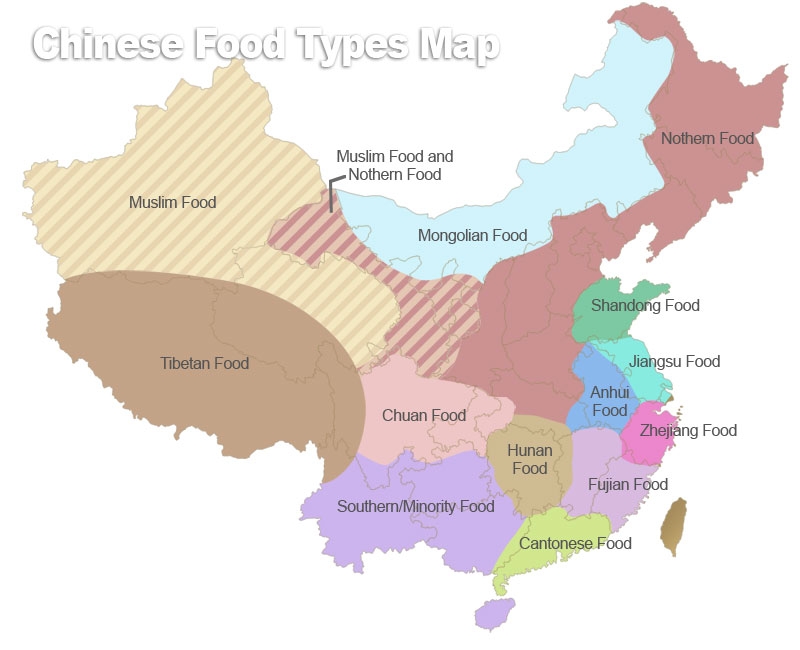
The ChinaHighlights map uses the 8 traditional cuisines, but adds in the other regions and names them as well. This is a pretty useful organization for chinese regional cuisine.  Of note, it refers to the Chuan people, an area more familiar to the westerner as Sichuan.


They include linked explanations for the other regions they name that are useful and can be generally applied.


Other views of the regions

Regions have been determined more methodically by the Beijing Computational Science Research Center based around the contents of an extensive cooking website, meishij.net. As an English speaker and reader, access that site via Google Chrome so you can use the built-in translations. It will still be pretty hard to understand, but you'll understand some of it at least. 


It shares a lot of similarities with the China Highlights map, but refines a few of the larger regions into new categories. You should read the entire article at The Atlantic on the topic. 


Some useful links on the topic of Chinese Regional Cooking


Book list

I've read these books that concern themselves with regionality in Chinese Cuisine and find them useful to various degrees.

The Gourmet Chinese Regional Cookbook by Calvin Lee I own this as an ebook. It's pretty good to cook from, and the dishes are linked to a region. There's not a lot of insightful regional analysis.

Tibetan Cooking by Elizabeth Kelly, another ebook. I'm a little concerned by her willingness to use olive oil. It's very simple cooking and writing. I don't have much to compare it against and I have a hunch there's been quite a bit of adaptation and simplification for casual western cooks.

Cooking from China's Fujian Province by Jaqueline Newman. An ebook again. I'm quite impressed with this one and recommend it. You may well have some difficulty with finding hong zhao, wine sediment, but a recipe for a substitute is included.

Chinese Regional Cooking by Kenneth Lo. This is out of print, but you can get it at Alibris and other used book sellers. This  works through restaurant recipes and other sources. Content is very traditional and not so much like what westerners tend to encounter.

Land of Plenty by Fuchsia Dunlop focuses on Sichuan cuisine. A good book with well tested recipes and explanations of ingredients and cuisine.

Revolutionary Chinese Cookbook by Fuchsia Dunlop focuses on Hunan Cuisine, the home of Chairman Mao. Again, excellent.

New Cantonese by Eileen Yin Fei Lo obviously focuses on contemporary Cantonese food and is a pleasing book to cook from.

Friday, March 14, 2014

Enjoying some Dim Sum

Tried out The Dim Sum House this week and enjoyed ourselves.

Beef Rice Roll in back and Shrimp in front. I enjoy rice rolls in general.


Seems the cook had a hard time with the shrimp roll. Noodle was a little thinner and the sauce not quite as distinct as at the Red Maple. I enjoyed them, they were good.

Same rolls from my wife's perspective. They look better from her angle.


Had to have some Pot Stickers.


These were large as pot stickers go. We ended up ordering three sets of these over the meal as the kids kept wanting some more. The wrapper varied in thickness on each one and tended to be a little thick. Flavor was good.  Red Maple's wrappers are thicker still so The Dim Sum House wins on the wrapper. Still, David's Kitchen sets a very high bar for Pot Stickers and sauce.

Things are starting to get interesting. Clockwise from the upper left: Steamed Malaysian yellow cake, Steamed Spare ribs in black bean sauce, Shu Mai, Shu Mai again, Phoenix Claws (center), and beef meatballs with bean curd wrap.

The wife's nexus 7 took a better picture.

The Steamed Spare ribs were something I've not see before elsewhere. They had a lighter sweeter flavor than I expected from the fermented black bean description and were well received. You could taste the black beans of course, it was just more delicate than most black bean preparations. 

The Shu Mai was good, not special. It's always popular with my family.  I'm not sure what they did for that hot pink decoration. 

My kids won't eat the chicken feet, but I always enjoy them too. It's more a textural thing and the sauce on these was quite good. Very similar to the one I used when I made them. I've only made them once as they turned out to be labor intensive. Kind of like most dim sum, it's something I prefer to order rather than make. 

I've got a package of bean curd skin in my pantry. I've only had bean curd skin once before and I've not cooked with it so I was interested to see what they did with it here on the meatballs. I enjoyed them, but the bean curd wrap really was more of a wimpy nest. I was hoping for more texture than they delivered though I enjoyed them all the same.

Green onion pancakes. These are the first of these I've had in a restaurant. They were thinner and browner than when I've made them. They were popular among us and I'll tweak my own next I make them.


This is a pan fried pork bun. Didn't get a picture until I was dividing up the last bit. This had a sort of slippery filling and was quite good. It was recommended to us by the staff and was worth trying.


Here's the sweet selections. The steamed yellow cake, of which I'm always a fan.  Usually, this is a thin rolled cake where this was a large highly risen cut. Flavor was the same though this wasn't as dense. I think i like the dense style a little better.

And a custard bun described as Steamed Golden Egg Yolk Buns, Hong Kong Style. The filling was runny and a little gritty with sugar, but that seems to have been by design. Something we've not tried before, but was quite popular. A second tray was selected as well.


Mango pudding. These ended up coming home as we were too full by the time we got around to them.


The Dim Sum House is worth visiting again for dim sum.

Yelp reviews