I've discussed Soy Sauce before. In that post, I mentioned the difference between the plastic jug of Pearl River Bridge and the bottle with the same label. The jug soy was saltier. Recently, those labels became consistent and the bottled soy is now rated at the higher sodium level.
I had thought I was just using less than before or my taste was changing, but this is also an explanation.
I don't like the low sodium Kikkoman soy sauce really, though its the easiest to find. My preferences run toward naturally brewed sauces over the forced fermentation sauces. I do like the Amoy First Extract soy sauce and it's only 100 mg more sodium than Pearl River Bridge's old sodium rating. That might become my preference. And I picked up some brewed Lee Kum Kee reduced sodium soy sauce as well to try.
I'll let you know what I end up choosing.
Tuesday, August 6, 2013

Wednesday, July 24, 2013
Experiment: Oil Poaching in Sesame Oil
While the Chinese have used a sort of oil poaching technique for velveting and par cooking of meat and such for a long time, in the West, oil poaching has been more a specialty technique for cooking seafood.
Use a flavorful fat like butter or olive oil, keep the temperature low and use a protein that will take on the best character of the fat. Thus the use of lobster or such as the most frequent protein poaching in butter. It's very good too.
Ming Tsai has a recipe for tuna in blend of oils that include sesame oil. But I thought that a pork tenderloin would also be well suited to this technique and use only toasted sesame oil. Googling, I found a picture of a pork tenderloin a restaurant oil poaches, but not any real details on the method.


Here, I'm bringing the oil up to temperature. Note the temp is set to 180 degrees, I don't want to fry this roast, just poach it to about 140 internal temperature. Using an induction burner really made holding the right poaching temperature much easier.


Carve it and then I dressed it with with a sauce like you would use on a steamed fish. Sizzling hot sesame oil (from the poaching oil), scallion, some soy and rice wine. The outer edge color looks better after carving as you get the contrast with the pink interior.

A better knife and fork meal than a chopstick one. Something I'll revisit and tweak on to build a recipe that you can follow some time in the future.

The leftover sesame oil can be kept for a couple of weeks REFRIGERATED. As it's infused with garlic and ginger it's at risk of growing botulism. You can keep it only for a short time. This is true of many of the flavored oils used in Chinese cooking that are home-made. Sadly, this is rarely discussed. I'll cover this in a post soon.
Use a flavorful fat like butter or olive oil, keep the temperature low and use a protein that will take on the best character of the fat. Thus the use of lobster or such as the most frequent protein poaching in butter. It's very good too.
Ming Tsai has a recipe for tuna in blend of oils that include sesame oil. But I thought that a pork tenderloin would also be well suited to this technique and use only toasted sesame oil. Googling, I found a picture of a pork tenderloin a restaurant oil poaches, but not any real details on the method.
- I needed to find the right pot that would hold the tenderloin snugly and minimize the amount of oil needed.
- I wanted to flavor the oil.
- I wanted the meat to have a roasted look instead of the grayness of just poaching at a low temperature.

For flavor, ginger, garlic, star anise, a little cinnamon stick and some Sichuan peppercorns. In the end, this wasn't enough and I'll also change my technique a bit next time I try this. I was afraid the cinnamon would overpower it so I used only a tiny bit. I was wrong. For fish, this would have probably been too strongly flavored from the sesame oil.
For color on the roast, I painted it with a mixture of dark soy, soy and rice wine. This is after three coats, drying about 10 minutes in between. This too came out lighter than I wanted so I'd do more coats, and maybe add a some red food coloring to punch it up a bit.


Here, I'm bringing the oil up to temperature. Note the temp is set to 180 degrees, I don't want to fry this roast, just poach it to about 140 internal temperature. Using an induction burner really made holding the right poaching temperature much easier.

Here it is after 50 minutes in the 180 degree oil. It's 145, so a bit higher than I wanted, but still just pink inside. I wasn't sure how long it would take to get to temp and it will vary with your equipment if you try this. Monitor it carefully. Let it rest 10 or 15 minutes before carving.

Carve it and then I dressed it with with a sauce like you would use on a steamed fish. Sizzling hot sesame oil (from the poaching oil), scallion, some soy and rice wine. The outer edge color looks better after carving as you get the contrast with the pink interior.

A better knife and fork meal than a chopstick one. Something I'll revisit and tweak on to build a recipe that you can follow some time in the future.

The leftover sesame oil can be kept for a couple of weeks REFRIGERATED. As it's infused with garlic and ginger it's at risk of growing botulism. You can keep it only for a short time. This is true of many of the flavored oils used in Chinese cooking that are home-made. Sadly, this is rarely discussed. I'll cover this in a post soon.
Sunday, June 16, 2013
Towards a Theory of Chinese Marinades: Part 3--Beef
While looking through my copy of Mai Leung's New Classic Chinese Cookbook, I noticed something interesting in her stir-fried beef recipes. She never used ShaoHsing wine or other alcohol for the marinade, but always sugar. Usually brown sugar. So I pored through my other books and here's what I noted.
There is a general trend away from wine in beef marinades and using sugar instead. Sugar is often used instead of wine as I noted in Part 1. It's not universal with the beef though. And it's more pronounced the older the source material is.
The other interesting thing that correlates with the age of the source material is that beef for stir-fries was universally velveted in the older cookbooks. Ken Lo, Virginia Lee, Mai Leung velvet beef for stir-fries. Nina Simonds not so much, Fuchsia Dunlop rarely, Ken Hom rarely in his modern work either.
In her Cantonese cookbook, Eileen Yin Fei Lo uses a small amount of wine, 1 teaspoon, with 1/2 teaspoon of ginger juice quite frequently with beef marinades. But her other books trend away from that and towards sugar.
Historically, beef was not a common ingredient. Cattle were work animals primarily and there wasn't enough arable land to dedicate to feeding beef solely for food purposes. So the beef that did make it to stir fries was likely tough. And velveting helps mask that. Further, the oil blanching of beef, even if not velveted, is the easiest only reliable method to cook thinly sliced beef evenly to only medium or medium rare.
Also, beef is more of a Northern food item, and the rice for the wine is more of a Southern food item. So geography plays in to this trend somewhat too.
But in the modern kitchen, deep frying has a negative connotation for health. Plus all that oil is extra work and mess. And commercial beef in the West is tender.
Given these factors, modern stir-fries tend to use equal parts ShaoHsing to Soy sauce in the marinades. And usually in slightly heavier doses than for pork or chicken which are more subtle and nuanced in taste to begin with.
So consider sugar next time you're stir-frying beef. And also think about oil blanching it to keep it pink in the center.
Part 1
Part 2
Part 4
There is a general trend away from wine in beef marinades and using sugar instead. Sugar is often used instead of wine as I noted in Part 1. It's not universal with the beef though. And it's more pronounced the older the source material is.
The other interesting thing that correlates with the age of the source material is that beef for stir-fries was universally velveted in the older cookbooks. Ken Lo, Virginia Lee, Mai Leung velvet beef for stir-fries. Nina Simonds not so much, Fuchsia Dunlop rarely, Ken Hom rarely in his modern work either.
In her Cantonese cookbook, Eileen Yin Fei Lo uses a small amount of wine, 1 teaspoon, with 1/2 teaspoon of ginger juice quite frequently with beef marinades. But her other books trend away from that and towards sugar.
Historically, beef was not a common ingredient. Cattle were work animals primarily and there wasn't enough arable land to dedicate to feeding beef solely for food purposes. So the beef that did make it to stir fries was likely tough. And velveting helps mask that. Further, the oil blanching of beef, even if not velveted, is the easiest only reliable method to cook thinly sliced beef evenly to only medium or medium rare.
Also, beef is more of a Northern food item, and the rice for the wine is more of a Southern food item. So geography plays in to this trend somewhat too.
But in the modern kitchen, deep frying has a negative connotation for health. Plus all that oil is extra work and mess. And commercial beef in the West is tender.
Given these factors, modern stir-fries tend to use equal parts ShaoHsing to Soy sauce in the marinades. And usually in slightly heavier doses than for pork or chicken which are more subtle and nuanced in taste to begin with.
So consider sugar next time you're stir-frying beef. And also think about oil blanching it to keep it pink in the center.
Part 1
Part 2
Part 4
Sunday, April 28, 2013
Towards a theory of Chinese Marinades: Part 2
The traditional method for marinades in the west has been to work with acid and oil as the basis. The acid was to help tenderize and flavor the meat, the oil to improve the mouthfeel and succulence of the final product.
It doesn't really work on cuts of meat common in the west and is dropping from favor.
First off, there's no real penetration of flavor beyond the outer 1/4 inch. Secondly, the acid tended to make the meat mushy and the oil didn't offer much most of the time.
These marinades have fallen from favor in the west, and rightly so. However, with the thinly sliced meats of many asian cuisines, this sort of marinade for the shorter times still has some value. Or if you're cooking thin cutlets or paillards, don't discard the standard marinade technique either.
Of interest though is the rise of salt, glutamate and nucleotide marination. Salt and glutamates can penetrate deeply in meat in common marination times. Cook's Illustrated, particularly in their PBS shows America's Test Kitchen and Cook's Country have pushed this sort of marinade into the public eye.
Glutamate combined with nucleotides offer a boosted savoriness to a dish. The common example is Caesar Salad with glutamate from the Parmesan cheese and nucleotides from the anchovies.
What does any of this mean for Asian marinades.
Soy sauce is salty of course, but also a good source of glutamates. The rice wine, is acidic as well as offering it's own flavors. Wikipedia offers a good list for common foods high in glutamate. Scroll down to the section on Concentration in Foods.
Salt penetrates into the meat. Depending on the length of time and concentration, salt can denature protein and help retain moisture as seen in the popularity of brining, or the recommendation of Kosher poultry, which has been salted as part of the Kosher butchering. This last part doesn't really apply to marinades in general, but I do sometimes wonder about it Asian food where the meat is so thin. In the first link below, Jack Bishop indicates it does, but that seems fast compared to the effect in brining so I still wonder.
Fish sauce offers nucleotides. Also other meaty products that often show up in the completed dish such as mushroom, mushroom based condiments, and stock are more sources of nucleotides.
It seems that the Asians had stumbled into this combination of flavors intuitively.
Worth reading for more information:
Part 1
Part 3
Part 4
It doesn't really work on cuts of meat common in the west and is dropping from favor.
First off, there's no real penetration of flavor beyond the outer 1/4 inch. Secondly, the acid tended to make the meat mushy and the oil didn't offer much most of the time.
These marinades have fallen from favor in the west, and rightly so. However, with the thinly sliced meats of many asian cuisines, this sort of marinade for the shorter times still has some value. Or if you're cooking thin cutlets or paillards, don't discard the standard marinade technique either.
Of interest though is the rise of salt, glutamate and nucleotide marination. Salt and glutamates can penetrate deeply in meat in common marination times. Cook's Illustrated, particularly in their PBS shows America's Test Kitchen and Cook's Country have pushed this sort of marinade into the public eye.
Glutamate combined with nucleotides offer a boosted savoriness to a dish. The common example is Caesar Salad with glutamate from the Parmesan cheese and nucleotides from the anchovies.
What does any of this mean for Asian marinades.
Soy sauce is salty of course, but also a good source of glutamates. The rice wine, is acidic as well as offering it's own flavors. Wikipedia offers a good list for common foods high in glutamate. Scroll down to the section on Concentration in Foods.
Salt penetrates into the meat. Depending on the length of time and concentration, salt can denature protein and help retain moisture as seen in the popularity of brining, or the recommendation of Kosher poultry, which has been salted as part of the Kosher butchering. This last part doesn't really apply to marinades in general, but I do sometimes wonder about it Asian food where the meat is so thin. In the first link below, Jack Bishop indicates it does, but that seems fast compared to the effect in brining so I still wonder.
Fish sauce offers nucleotides. Also other meaty products that often show up in the completed dish such as mushroom, mushroom based condiments, and stock are more sources of nucleotides.
It seems that the Asians had stumbled into this combination of flavors intuitively.
Worth reading for more information:
- NPR interview with America's Test Kitchen
- Culinary Guild interview with a Test Kitchen employee, particularly the last third or so
- IFT article on umami
- CJBIO actually about nucleotides as a food additive, but still interesting and with some good information
- Principles of Food Chemistry via Google Books the section titled Flavor Enhancers
Part 1
Part 3
Part 4
Friday, March 22, 2013
CNN: 50 best Chinese Restaurants in the US
CNN has a fun listing of what they consider the best Chinese Restaurants in the US. The two they picked for my area, Utah, are certainly good choices. But Red Maple is no longer at that location as they had an oil fire that ruined the kitchen.
They're supposed to be re-opening in a new location soon out in Taylorsville. Originally, they were supposed to open in January, but they're still not open yet.
There have been some who disagree that Red Maple is particularly good. Lisa Dang's blog has a pointed critique with some valid points. And I think they're sloppy with too much oil in many of their stir fries, but Red Maple is better than most of the other Chinese places in Salt Lake City.
I look forward to their re-opening and need to give the Golden Dragon's dim sum a try.
They're supposed to be re-opening in a new location soon out in Taylorsville. Originally, they were supposed to open in January, but they're still not open yet.
There have been some who disagree that Red Maple is particularly good. Lisa Dang's blog has a pointed critique with some valid points. And I think they're sloppy with too much oil in many of their stir fries, but Red Maple is better than most of the other Chinese places in Salt Lake City.
I look forward to their re-opening and need to give the Golden Dragon's dim sum a try.
Sunday, February 3, 2013
Cheater Hot Wings
Hot wings in the classic Buffalo style are good.They're messy to make with all the frying and butter based sauce. And messy to eat as well. So I usually take the easy way out with hot wings and start with prepared and fully cooked hot wings. Then I augment it with some extra flavor and smoke. If you don't have a smoker, they're also good grilled. Beyond the flavor boost, the cooking renders out some fat, improves the texture of the skin and turns the messy sauce into a nice glaze.
This is what Costco in my area carries and it works well.

Set up your smoker or start heating your grill. Even the broiler improves the wings if you don't have a grill.
Lay them out on the rack. Season with a Cajun seasoning. There's a lot of good ones commercially available, but I usually make my own blend without salt. This lets me build the Cajun flavors with out the dish getting too salty. I'll give my Cajun blend at the end of this post.

In summer weather, I smoke the wings for a total of 2 hours. Turn them at the halfway point and season the other side with more Cajun seasoning. If you're using a grill or broiler, watch them for picking up grill marks, darker color and drier appearance.
But this time, it was 40 degrees outside so they were cooking slower. They needed 90 minutes on a side to cook to the proper texture.


While the wings finish up, prepare a barbecue ranch dipping sauce. This is very simple too, just equal parts Ranch dressing and barbecue sauce of your choice. I used about 1/4 cup of each. In this case, I'm using Stubb's Smokey Mesquite barbecue sauce though I often use Stubb's Spicy barbecue sauce.

Stir to mix.

So in winter weather, at the end of three hours, they were nicely smokey and ready for eating.

Server the wings with the sauce and enjoy.

Salt Free Cajun Seasoning
I'm a fan of the guajillo pepper so I use it here. It's not traditional and if you prefer cayenne, which is traditional, then use 1/4 teaspoon of that instead. Adjust up or down to match your heat preference.
- 1 tablespoon paprika
- 2 teaspoons garlic powder
- 1 teaspoon onion powder
- 1 teaspoon dried oregano
- 1/2 teaspoon dried thyme
- 1/2 teaspoon ground black pepper
- 1/2 teaspoon groundwhite pepper
- 1/2 teaspoon ground guajillo pepper
Other fun additions are some ground mustard, a little ground bay leaf, dried basil. Many good variations are possible.
Thursday, January 17, 2013
Funeral Potatoes
A note about the pictures this time. I'm experimenting with a High
Dynamic Range photo app on my phone. So you'll notice some odd
highlights in some of the pictures as I figure this out.
In my neck of the woods, Funeral Potatoes means a mixture of convenience items mixed together and served by caring friends and neighbors to the grieving family after the funeral services.
It's basically a form of Au Gratin potatoes itself a variation on the classic Gratin Dauphinois (Wikipedia details link). I've never successfully made Gratin Dauphinois. It always curdles on me. I think it's because of my altitude and that the cream comes to a boil at a lower temp than lower elevations. So I've come to rely on a roux-based bechamel sauce to reinforce my sauce for these sorts of potato dishes.
I needed to hurry things along, so I chopped up potatoes and set them to simmer in some seasoned water.
 This
is about 10 cups total of 3/8 inch cubes raw russett potato. The water
is seasoned with some kosher salt (1 teaspoon), onion powder (1/2
teaspon), garlic powder (1/4 teaspoon) and dried thyme (1/2 teaspoon) These are the flavors I wanted to infuse into the potato. Simmer the potatoes about 15 minutes. They'll be mostly cooked but not completely so at that point.
This
is about 10 cups total of 3/8 inch cubes raw russett potato. The water
is seasoned with some kosher salt (1 teaspoon), onion powder (1/2
teaspon), garlic powder (1/4 teaspoon) and dried thyme (1/2 teaspoon) These are the flavors I wanted to infuse into the potato. Simmer the potatoes about 15 minutes. They'll be mostly cooked but not completely so at that point.
 While that's coming to a simmer, I chopped up 4 green onions, green and white parts.

And minced 2 cloves of garlic. Whack the clove or garlic wtih the flat side of your chef knife. This breaks the clove up a bit and loosens the skin from the clove of garlic. Pick out the skin.

Chop it up.

Sprinkle it with kosher salt.


Repeat that a few times to create a garlic paste.

Melted 3 tablespoons of butter, whisked in 4 tablespoons of flour to form a roux.

Let it cook a minute or so to cook out the flour. In the last 30 seconds of that roux cooking, add the minced garlic and stir to develop it's flavor.
Add 2 cups of milk, whisk to form a bechamel.
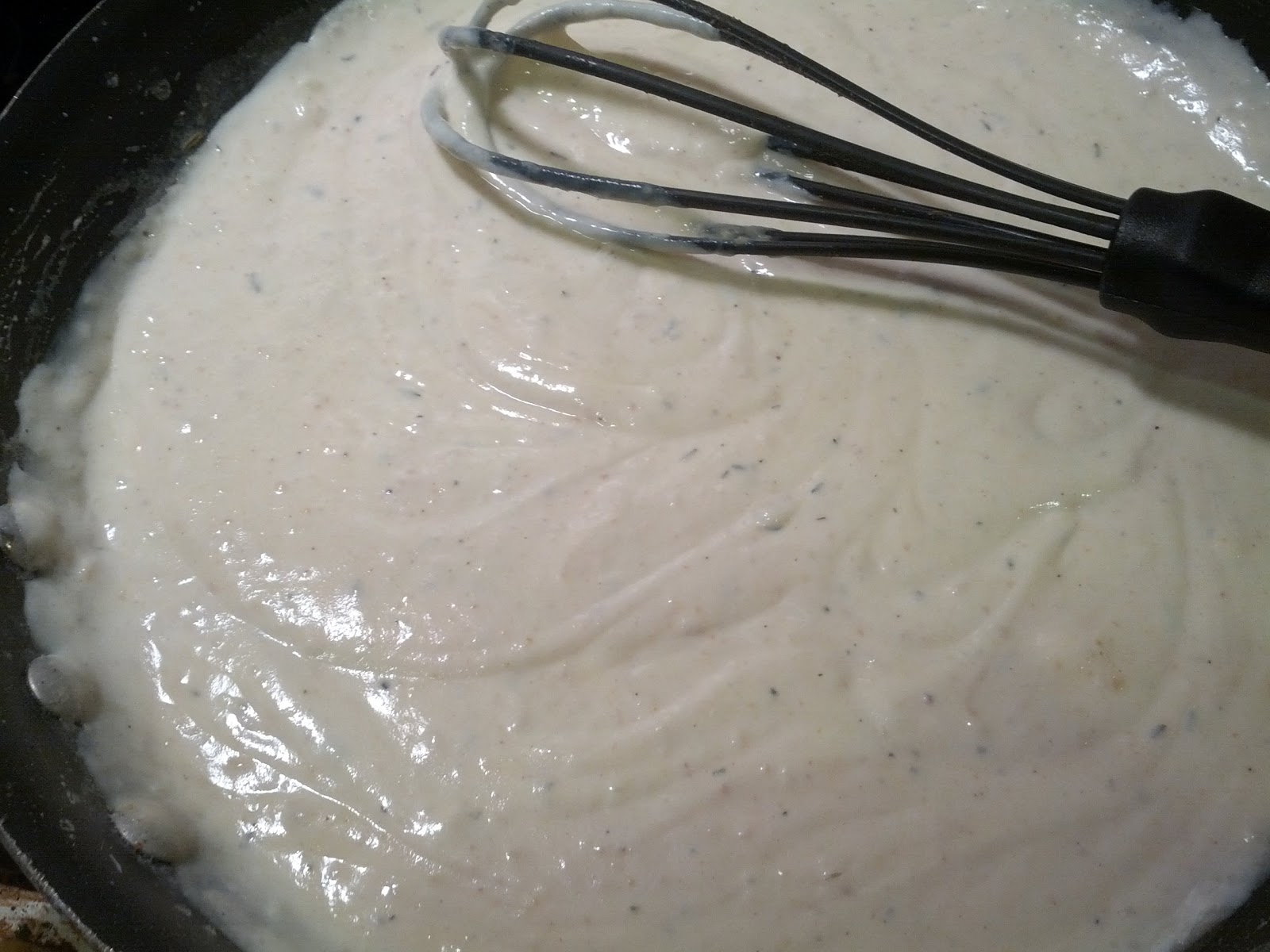
Where funeral potatoes use a can of cream of something soup, I opt for a simplified Supreme Sauce (a form of veloute) instead, being a sort of comination of bechamel and chicken stock thickened with roux.
Season with 3 teaspoons chicken base. 1/2-1 teaspoon dried thyme, pepper to taste. Continue cooking until it thickens and starts to boil.

Add 2 cups sour cream and mix together.

Grate parmesan cheese. This is hard to give a consistent measure for as people's graters are different and so the result packs differently. So it's about an ounce to an ounce and a half of freshly grated parmesan. i grate mine on a Microplane grater. This will provide extra cheese impact in the dish without looking so heavily full of cheese and dense.

Add the cheese and the onions to the sauce.

Combine. Taste and correct seasoning as needed.

Add the drained potatoes to the mix--they should be about done now anyway or cook further as needed to the par-cooked stage.

Stir to combine.

Sprinkle on about 1/4 cup grated sharp cheddar cheese. This is mostly for looks so there will be strands of orange cheese in the casserole.


Pour all that into a 9x13 baking dish.


Top with grated cheddarBake at 350 until bubbly and the top has browned, about 30-40 minutes

Serve while hot.
In my neck of the woods, Funeral Potatoes means a mixture of convenience items mixed together and served by caring friends and neighbors to the grieving family after the funeral services.
It's basically a form of Au Gratin potatoes itself a variation on the classic Gratin Dauphinois (Wikipedia details link). I've never successfully made Gratin Dauphinois. It always curdles on me. I think it's because of my altitude and that the cream comes to a boil at a lower temp than lower elevations. So I've come to rely on a roux-based bechamel sauce to reinforce my sauce for these sorts of potato dishes.
I needed to hurry things along, so I chopped up potatoes and set them to simmer in some seasoned water.


And minced 2 cloves of garlic. Whack the clove or garlic wtih the flat side of your chef knife. This breaks the clove up a bit and loosens the skin from the clove of garlic. Pick out the skin.

Chop it up.

Sprinkle it with kosher salt.

Drag the knife edge across the garlic and salt with some force. You'll feel and hear the salt grains cut apart and grind the garlic.

Repeat that a few times to create a garlic paste.

Melted 3 tablespoons of butter, whisked in 4 tablespoons of flour to form a roux.

Let it cook a minute or so to cook out the flour. In the last 30 seconds of that roux cooking, add the minced garlic and stir to develop it's flavor.
Add 2 cups of milk, whisk to form a bechamel.
Where funeral potatoes use a can of cream of something soup, I opt for a simplified Supreme Sauce (a form of veloute) instead, being a sort of comination of bechamel and chicken stock thickened with roux.
Season with 3 teaspoons chicken base. 1/2-1 teaspoon dried thyme, pepper to taste. Continue cooking until it thickens and starts to boil.

Add 2 cups sour cream and mix together.
Grate parmesan cheese. This is hard to give a consistent measure for as people's graters are different and so the result packs differently. So it's about an ounce to an ounce and a half of freshly grated parmesan. i grate mine on a Microplane grater. This will provide extra cheese impact in the dish without looking so heavily full of cheese and dense.

Add the cheese and the onions to the sauce.

Combine. Taste and correct seasoning as needed.

Add the drained potatoes to the mix--they should be about done now anyway or cook further as needed to the par-cooked stage.

Stir to combine.

Sprinkle on about 1/4 cup grated sharp cheddar cheese. This is mostly for looks so there will be strands of orange cheese in the casserole.


Pour all that into a 9x13 baking dish.


Top with grated cheddarBake at 350 until bubbly and the top has browned, about 30-40 minutes

Serve while hot.
Subscribe to:
Posts (Atom)